Yercaud Coffee
Five Roam Coffee · Updated
Yercaud is a hill town in the Shevaroy Hills of Salem district, Tamil Nadu, and it has grown coffee for two centuries. Unlike most Indian coffee, which grows in the Western Ghats, Yercaud coffee grows in the Eastern Ghats. Five of our coffees come from its estates.
Where Yercaud coffee grows
The Shevaroy Hills, also called the Servarayan Hills, rise out of the plains around Salem. The town of Yercaud sits at about 1,515 m. Coffee estates spread across the slopes around it, mostly under the shade of tall trees.
Our Yercaud lots grow between 1,380 and 1,520 m. That height matters: cooler nights slow the ripening of the cherry, and arabica grown high tends to have more acidity and more aromatic flavour than coffee grown lower down.
A short history
Coffee came to the Shevaroys in the 1820s. M. D. Cockburn, then the collector of Salem district, helped set up the first coffee plantations, along with citrus brought in from South Africa. The hills later became a retreat for officials of the Madras Presidency, but the coffee stayed: Moganad, Stanmore, Orchardale and Bison Valley, where our lots come from, all grow on these slopes today.
What Yercaud coffee tastes like
Yercaud arabica is bright and fruity rather than heavy. Where Chikmagalur coffee leans to cocoa and nuts, Yercaud lots lean to fruit, sweetness and a lively acidity. Process changes the cup a great deal, and the Yercaud estates we buy from use several:
- Natural process, dried in the whole cherry, gives deep red and dark fruit.
- Washed process gives a cleaner cup with clearer sweetness.
- Fermented and sugar processed lots add layers of sweetness on top.
Our Washed vs Natural Coffee guide explains how each process works.
Our Yercaud coffees
- Mulberry Wine: washed and triple fermented, from Moganad Estate at 1,380 m. Mulberry, peach and palm sugar. Cupped at 86.8.
- Brown Sugar Trails: washed and processed with brown sugar, from Bison Valley at 1,380 m. Brown sugar, berries and nuts. Cupped at 86.25.
- Sangria Silk: natural, from Stanmore Estate at 1,400 m. Red fruit, black cherry and candied fennel, roasted Light or Medium-Light.
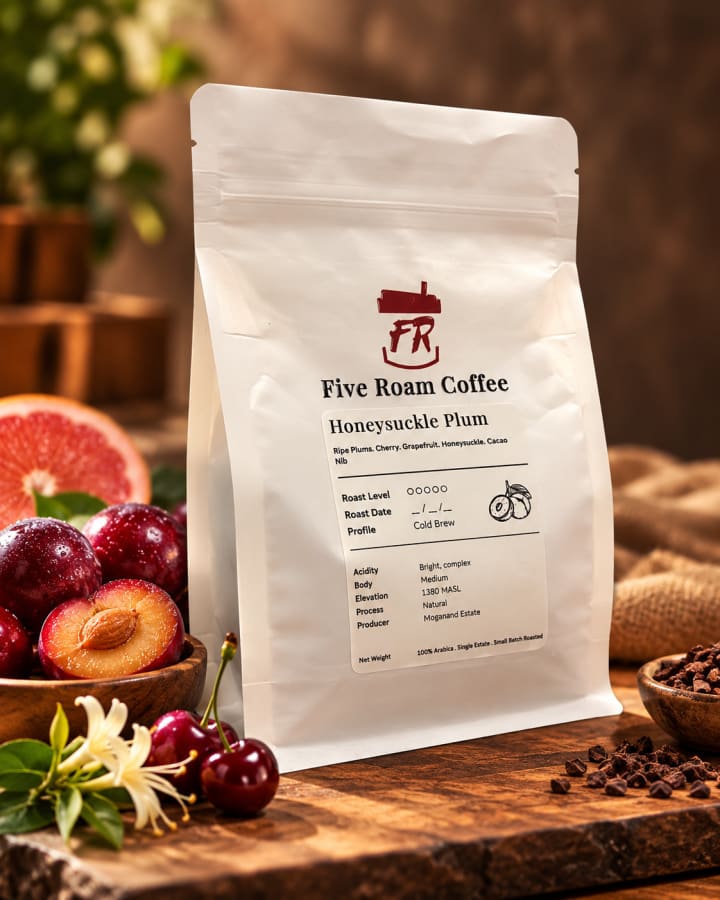
- Honeysuckle Plum: natural, from Moganad Estate at 1,380 m. Ripe plum, cherry, grapefruit, honeysuckle and cacao nib.
- Blueberry Compote: natural, from Orchardale Estate at 1,520 m, the highest of our Yercaud lots. Black cherry, blueberry and dark grapes.
The varieties are mostly SLN795 and SL9, arabica selections bred in India.
How to brew Yercaud coffee
Fruit and acidity show best in a clean, filtered cup.
- Pour over: shows the fruit and the bright acidity. See Pour Over, Step by Step.
- AeroPress: a sweet, clean cup. See Brew with AeroPress Step by Step.
- French press: a rounder, jammier cup. See French Press, Done Properly.
- Cold brew: the natural lots make a fruity, sweet glass. See Cold Brew, Made Right.
Frequently asked questions
Is Yercaud coffee arabica?
The Shevaroy Hills grow both arabica and robusta. All five of our Yercaud coffees are arabica.
When did coffee come to Yercaud?
In the 1820s, when M. D. Cockburn, the collector of Salem district, helped establish the first coffee plantations in the Shevaroy Hills.
How is Yercaud coffee different from Chikmagalur coffee?
Yercaud grows in the Eastern Ghats and our lots there lean to fruit and bright acidity. Chikmagalur grows in the Western Ghats and leans to cocoa, nuts and heavy body.