
French Press, Done Properly
Five Roam Coffee · Updated
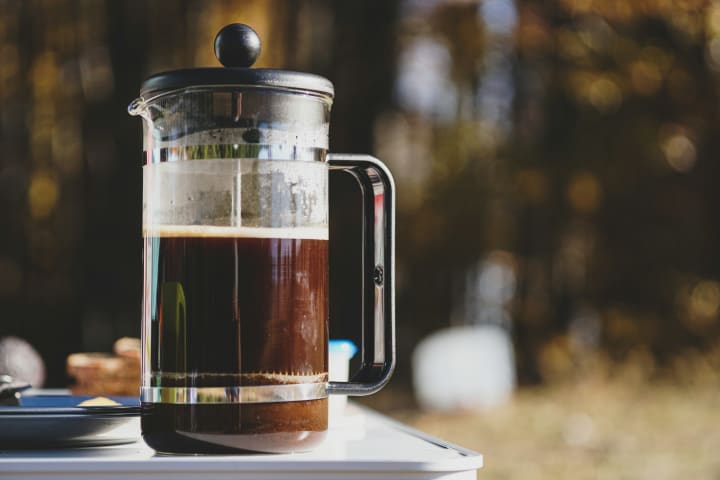
A French press makes a rich, full bodied cup with almost no technique. Its metal filter lets the coffee's natural oils through, which paper filters hold back, and that is where the heavier body comes from. This guide covers the quantities, each step and how to avoid a muddy or bitter cup.
What you need
- A French press, this guide uses a 3 cup press
- 30 g of coffee, ground coarse, about like coarse sea salt
- 450 g of water just off the boil
- A kettle, a kitchen scale and a timer
- A spoon or stirrer
Quick steps
- Add 30 g of coarsely ground coffee to the press.
- Pour in 450 g of water just off the boil.
- Stir once.
- Put the lid on with the plunger up and steep for four minutes.
- Press down over 15 to 20 seconds.
- Pour straight away.
How much coffee and water to use
The ratio is 1:15, one gram of coffee for every 15 grams of water.
- A 3 cup press: 30 g of coffee to 450 g of water
- A smaller brew: keep the 1:15 ratio, for example 20 g of coffee to 300 g of water
Fill the press no further than its own maximum line, even if the ratio says more water.
Step by step
- Boil the kettle and let it stand for a moment, so the water is just off the boil.
- Warm the press with a splash of hot water if you like, then pour it away.
- Add 30 g of coarsely ground coffee.
- Pour in all 450 g of water, wetting all the grounds.
- Give it one stir to break up any dry clumps.
- Put the lid on with the plunger pulled all the way up, so it does not touch the coffee yet.
- Steep for four minutes.
- Press the plunger down slowly and steadily over 15 to 20 seconds. If it pushes back hard, the grind is too fine; stop, and next time grind coarser.
- Pour all the coffee out straight away. Coffee left sitting on the grounds keeps extracting and turns bitter.
Why pour straight away
The press does not stop brewing when you plunge. The filter only pushes the grounds down; the coffee is still touching them. Pour every cup at once, or decant the rest into a jug or flask.
Which coffee to use
The heavier body of a French press suits coffees with plenty of fruit and sweetness.
- Honeysuckle Plum (natural) for ripe plums, cherry and grapefruit
- Blueberry Compote (natural) for black cherry, raisins and blueberry
- Brown Sugar Trails (washed, brown sugar process) if you want a cup with more complexity and berry notes
- Mulberry Wine (washed, triple fermentation) for mulberry and peach, with the dark fruit underneath a fuller body
If you buy your coffee ground, choose the French Press grind.
Troubleshooting
- Plunger is hard to push: the grind is too fine. Go coarser.
- Silty or muddy cup: the grind is too fine, or you poured the last drops from the bottom. Go coarser and leave the last of the coffee in the press.
- Bitter: the coffee sat on the grounds too long. Pour straight after pressing.
- Weak or thin: check you used 30 g of coffee to 450 g of water and steeped the full four minutes.
Frequently asked questions
How long should French press coffee steep?
Four minutes, then press over 15 to 20 seconds and pour straight away.
What grind size is best for a French press?
Coarse or French Press Grind, about like coarse sea salt. A finer grind makes the plunger hard to push and leaves silt in the cup.
How much coffee do I use in a French press?
Use a 1:15 ratio. For a 3 cup press, that is 30 g of coffee to 450 g of water.
Why does French press coffee taste heavier than filter coffee?
The metal filter lets the coffee's oils through into the cup. A paper filter holds most of them back.