
Pour Over, Step by Step
Five Roam Coffee · Updated
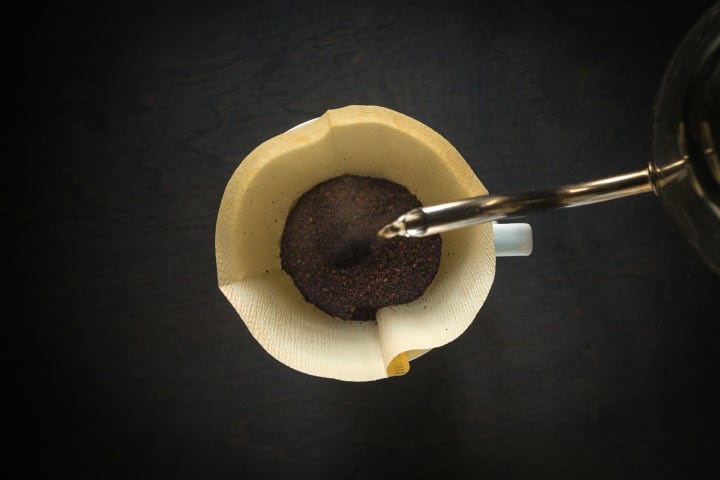
Pour over gives you the clearest view of what a coffee tastes like. You control the water by hand, so a little attention to grind, bloom and pour makes a clean, sweet cup. This guide covers what you need, the quantities, each step and how to fix a cup that is off.
What you need
- A pour over dripper and a paper filter that fits it
- 20 g of coffee, ground medium fine
- 320 g of water at 90 to 96°C (or 93°C as average), plus extra for rinsing
- A kettle, ideally one with a narrow spout
- A kitchen scale and a timer
- A carafe or mug to brew into
Quick steps
- Rinse the paper filter with hot water and pour that water away.
- Add 20 g of coffee and level the bed.
- Bloom with about 40 g of water for 30 to 45 seconds.
- Pour the rest in slow circles, finishing by about 2:00.
- Let it drain. Total brew time is 2:30 to 3:30.
How much coffee and water to use
The ratio is 1:16, one gram of coffee for every 16 grams of water.
- Two cups: 20 g of coffee to 320 g of water
- The bloom: about double the coffee's weight, so 40 g of water for 20 g of coffee
Put the dripper on the scale and zero it, so you can see exactly how much water has gone in.
Step by step
- Heat the water to 90 to 96°C. Just off the boil, after a short rest, is about right.
- Fold the paper filter along its seam, put it in the dripper and rinse it well with hot water. This takes away the papery taste and warms the dripper. Pour the rinse water away.
- Add 20 g of ground coffee and give the dripper a gentle shake so the bed is flat.
- Start the timer and pour about 40 g of water, enough to wet all the grounds.
- Wait 30 to 45 seconds. The bed rises and bubbles as fresh coffee releases gas. This is the bloom, and it lets the rest of the water extract evenly.
- Pour the remaining water in slow circles, from the centre outwards and back. Keep the stream off the filter wall, where water runs past the coffee without extracting it.
- Aim to have all 320 g poured by about 2:00.
- Let the water drain through. The brew should finish between 2:30 and 3:30.
- Lift off the dripper, swirl the carafe and serve.
Pour in stages or all at once?
You can pour the main water in two or three stages after the bloom, letting the level drop a little each time, or in one slow continuous pour. Both work. Stages are easier to control when you are learning; a continuous pour is quicker once your timing is steady. Whichever you choose, keep finishing by about 2:00.
Which coffee to use
Pour over shows the difference between processing methods clearly, so it is a good brewer for comparing our single origins.
- Sangria Silk (natural) for red fruit, black cherry and candied fennel, with a bright acidity
- Honeysuckle Plum (natural) for ripe plums, cherry and grapefruit
- Blueberry Compote (natural) for black cherry, raisins and blueberry
If you buy your coffee ground, choose the Pour Over grind.
Troubleshooting
- Sour or thin: the grind is too coarse or the water too cool. Grind finer, or use water at 90 to 96°C.
- Bitter or dry: the grind is too fine or the pour too slow. Grind coarser and keep the pour moving.
- Brew runs well past 3:30: grind a little coarser.
- Brew finishes well before 2:30: grind a little finer.
- Uneven or weak cup: pour in slow circles and keep the water off the filter wall.
Adjust one thing at a time so you can tell which change worked.
Frequently asked questions
What is the best ratio for pour over coffee?
1:16, one gram of coffee for every 16 grams of water. 20 g of coffee to 320 g of water makes about two cups.
Why do you bloom pour over coffee?
Freshly roasted coffee holds gas. A short bloom of about double the coffee's weight in water lets that gas escape, so the rest of the water can extract the coffee evenly.
How long should pour over take?
Finish pouring by about 2:00 and expect the brew to be done between 2:30 and 3:30.
What grind size is best for pour over?
Medium fine or Pour Over Grind. If the brew runs slow and tastes bitter, go coarser; if it runs fast and tastes sour, go finer.