
What Is Specialty Coffee?
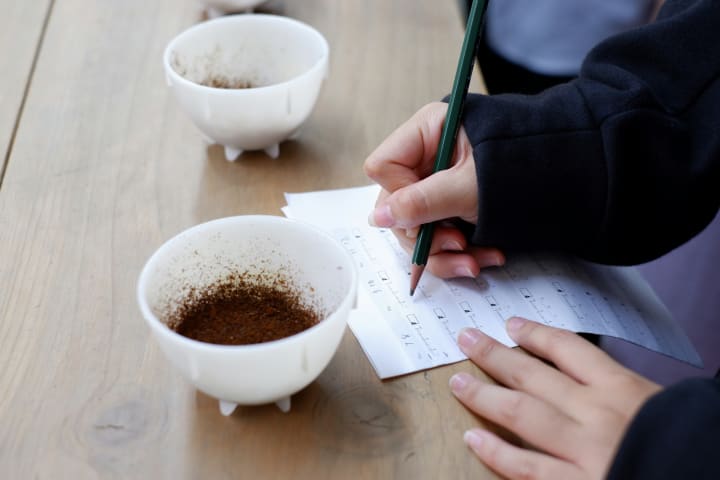
Almost every bag of coffee sold today calls itself premium, gourmet, or artisanal. None of those words mean anything in particular. Specialty is different: it is a grade, it is measured, and a coffee either clears the bar or it doesn't.
The number
The term dates to 1974, when Erna Knutsen used it in the Tea & Coffee Trade Journal for beans from special microclimates — coffee worth selling by its origin rather than by the sack. The trade built a standard around the idea, and today it runs on cupping: coffee brewed to a fixed recipe and tasted blind by Q Graders, licensed after an exam that tests palate and consistency. They score it out of 100 across ten attributes — aroma, flavour, aftertaste, acidity, body, balance, uniformity, clean cup, sweetness, and an overall mark.
Eighty is the line. At 80 and above, a coffee is specialty grade. Below it, commercial — which is most of the coffee in the world, and not an insult, just a different product, blended and traded by country rather than by farm. Above the line the bands keep going: 80 to 84.99 is very good, 85 to 89.99 excellent, 90-plus outstanding and genuinely rare. A coffee at 86 is not slightly better than one at 82. The Specialty Coffee Association is now rolling out a broader assessment to sit alongside that single score, but 80 remains the shorthand the whole trade runs on.
Before anyone tastes it
The cup score is only half the test. Green beans are graded for defects first, and the bar is strict: zero primary defects — no full blacks, sours, fungus damage or foreign matter — and no more than five full defects of any kind in a 350-gram sample. A 100-gram roasted sample must contain no quakers, the pale under-ripe beans that never brown properly. A coffee that cups beautifully and fails the defect count is not specialty grade.
The lot, not the country
Commodity coffee is anonymous by design: bought as "Brazil, screen 17", blended, and priced off a global futures market that has no idea what any particular farm grew. Specialty is bought as a lot, and the lot carries its record — estate, region, altitude, varietal, process, harvest. That record is the mechanism by which a better coffee pays a farmer more, and it is why a roaster can buy the same coffee again next season.
Why that record shows up in the cup
Altitude slows the cherry down: cooler nights stretch out ripening, the bean grows denser, and sugars and acids develop further. Processing decides much of the rest. Washed coffees, stripped of their fruit before drying, taste cleaner and more acidic. Naturals, dried whole inside the cherry, come out heavier and fruitier. Neither is better than the other — they are different intentions.
Freshness is not a detail
Specialty roasting runs lighter than commodity roasting, because a dark roast flattens origin character into roast character; past a point you are tasting the fire, not the farm. It is also why a specialty bag carries a roast date rather than a best-before two years out. Coffee is at its best from about a week after roasting, once it has released its carbon dioxide, through the month or so that follows.
Where ours comes from
India grows coffee almost entirely in shade, under native canopy in the Western and Eastern Ghats — unusual globally, and good for both the cup and the forest. Our lots come from Chikmagalur in Karnataka and Yercaud in Tamil Nadu. Whatever a lot scores, that number sits on its product page alongside the estate, altitude, process and varietal — and on the bag itself.
Which is the practical upshot of all of it. Buy coffee that tells you where it came from and when it was roasted. If a bag will not tell you either, that silence is the answer.