
What Is a Cup Score?
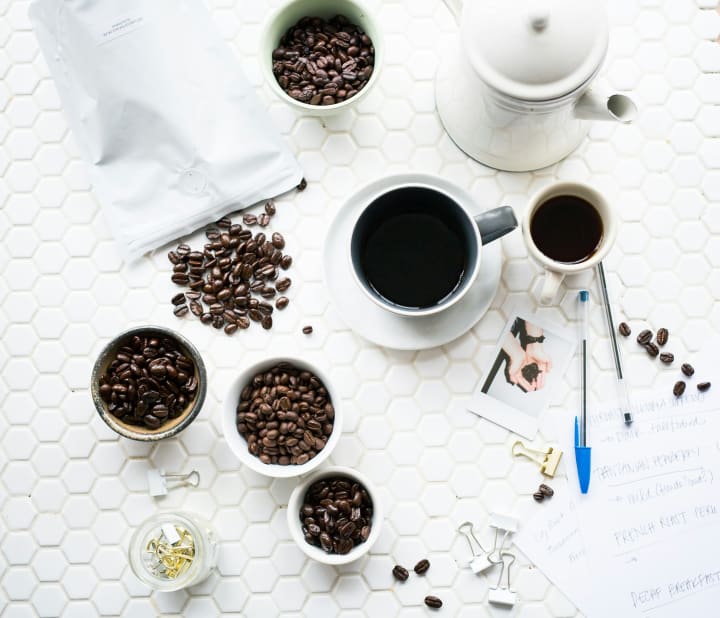
Every one of our coffees carries a number — 84, 86.5, 88. It is not a rating out of ten dressed up, and it is not marketing. It is the result of a defined procedure that a licensed grader followed in a room with a spoon, a form, and five identical cups. Here is what actually happens.
The setup is fixed on purpose
Cupping is standardised so that two graders in two countries are measuring the same thing. The ratio is roughly 8.25 grams of coffee to 150 millilitres of water — about 55 grams per litre — ground coarse, with water just off the boil at around 93°C.
Five cups are prepared from the same sample, not one. That matters: much of what the score measures is whether the lot is *consistent*, and you cannot see consistency in a single cup.
The grader smells the dry grounds first, then pours, then waits. At three to four minutes a crust of grounds has formed on top; breaking it with a spoon releases a burst of aroma that is assessed in that moment and never comes back. The coffee is then left to cool, because flavours separate as the temperature drops — a coffee is tasted repeatedly on the way down, not once while hot.
Samples are evaluated blind. The grader does not know the farm, the price, or what anyone hoped it would score.
Ten things are being judged
The form scores ten attributes. Six are judged on quality and marked from 6.00 to 10.00 in quarter-point steps: fragrance and aroma, flavour, aftertaste, acidity, body, and balance.
Two words there are routinely misread. Acidity is scored on *quality*, not quantity — a bright, sweet, structured acidity scores well and a sharp sour one does not, and a low-acid coffee is not penalised for being low-acid. Body is the same: it is the quality of the weight, not how heavy it is.
Three more attributes are scored across the five cups at two points each: uniformity, clean cup, and sweetness. A single odd cup in five costs two points, which is how an inconsistent lot gets found out.
The last is overall — the grader's own judgment of the coffee as a whole, the one place personal assessment is explicitly allowed.
Defects are then subtracted. A taint, an off-flavour that is noticeable but not ruinous, costs two points per affected cup. A fault, one that makes the cup genuinely unpleasant, costs four.
Why 80 is higher than it sounds
Because the quality attributes start at 6.00 rather than 0, the scale does not run from zero. A drinkable, unremarkable coffee with no defects lands somewhere in the low 70s. Eighty is not eighty percent of anything — it is a narrow band near the top, and the difference between 84 and 87 is a great deal larger than three points out of a hundred suggests.
Who is allowed to score
The number is only worth anything if it means the same thing in two different rooms, which is why the grading is licensed. A Q Grader qualifies through the Coffee Quality Institute by passing a series of examinations over several days — sensory tests, triangulations, acid and organic-acid identification, green grading, roast identification — and has to recalibrate periodically to keep the credential.
The exams are less about having a remarkable palate than about being *reliable*: scoring the same coffee the same way today, next month, and in someone else's cupping room.
What a score does not tell you
It does not tell you whether you will like the coffee. Preference is not what is being measured. A meticulous washed Colombian at 86 and an exuberant natural Ethiopian at 86 are not competing for the same palate, and the higher number between two coffees you are choosing from is not automatically the one you should buy.
It also belongs to a lot, not a farm. The same estate can produce an 87 one season and an 83 the next, and a score attached permanently to a producer's name rather than to a specific harvest is being used loosely.
And it describes the coffee as green, cupped correctly. Nothing in an 88 survives a stale bag or a bad grinder — the score is a ceiling you can fall well short of at home.
Reading it on our shelf
Each of our coffees lists its score on its product page, beside the estate, altitude, process and varietal for that specific lot. Together those tell you what the coffee is and how it was judged. The roast date on the bag tells you the rest.